AI agents for operations.
Improve recurring operational work by coordinating information, preparing actions, watching defined conditions and escalating exceptions, inside one controlled end-to-end workflow.
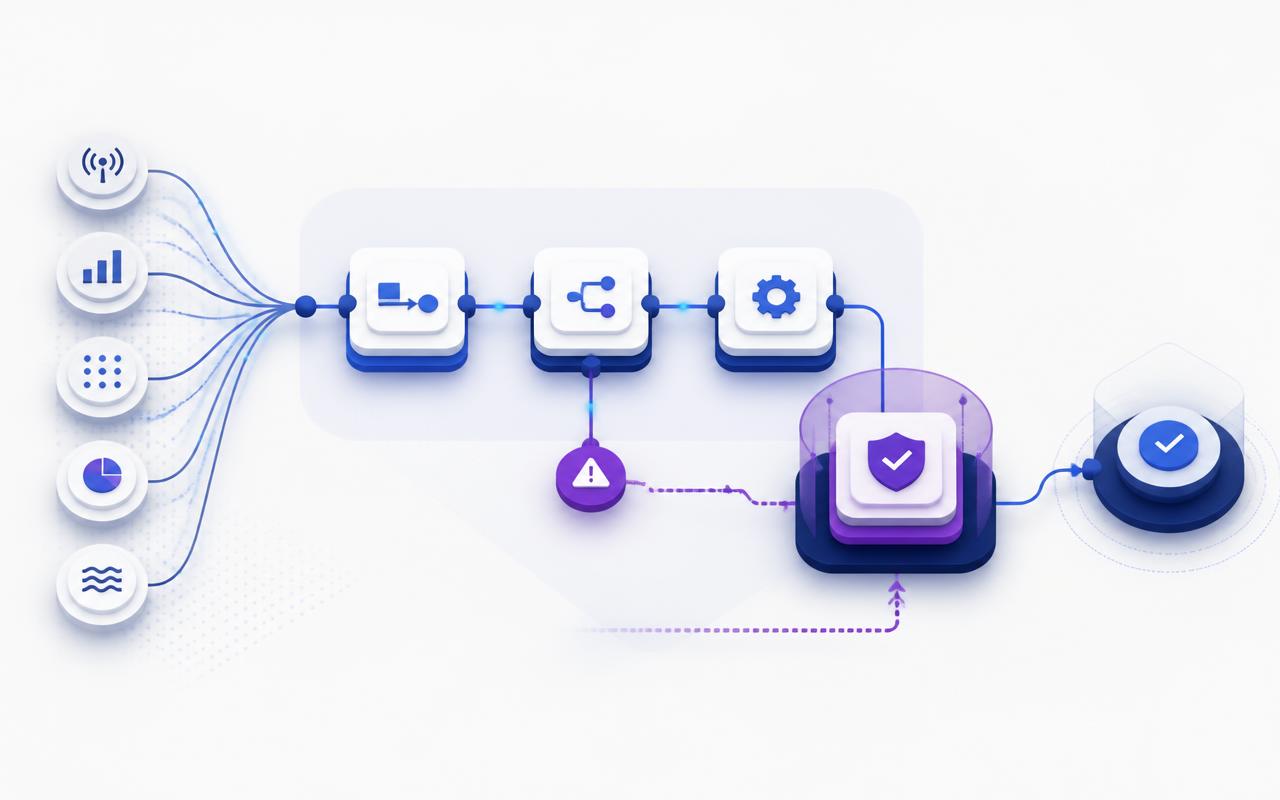
Where an agent can contribute
Depending on the workflow, an agent may support:
- Gathering operational context
- Coordinating recurring workflow steps
- Preparing routine actions
- Monitoring defined conditions
- Detecting missing inputs and exceptions
- Routing tasks and escalations
- Preparing status summaries
- Maintaining workflow records where approved
Optimising one task just moves the bottleneck to the next handoff.
We redesign the whole selected workflow and assign human and agent responsibilities around the points that actually determine throughput, quality and reliability.
That is the difference between a fast step and a faster workflow.
What could be measured
Illustrative KPI types, not promised results. The baseline and the success measure are agreed for your real workflow before implementation.
- Cycle time
- Throughput
- On-time completion
- Backlog size and age
- Exception rate
- Manual touches
- Rework rate
- Time to resolve exceptions
Questions about this workflow.
What kinds of operations workflows are suitable?
Ones that serve a real business priority, repeat often enough for an improvement to matter, contain meaningful manual coordination or preparation, and can be baselined.
It also needs a business owner and a way to make approvals explicit. Without those two the 30 days cannot start.
Can the agent monitor conditions and trigger actions?
Not without approval on the early runs. A person approves every real action, the agent runs in a sandbox first, and escalation rules are agreed before go-live. If it is unsure, it stops and asks.
The approval gates loosen only when you decide you are comfortable, not before.
Do we need a fully standardised workflow first?
No. If the workflow is not written down anywhere, we bring the framework and the best practice and define it with you.
That is one part of the engagement, not a separate consulting project.
Continue
What makes an AI agent governed
What a governed agent is, and the nine elements it needs to run in production.
Methodology
How we move from a business priority to a measured production result.
First AI Agent in 30 Days
One workflow, one production agent, one measured metric. Fixed scope.
AI Value Scan
A free 45-minute session to work out which workflow to start with.
Other use cases
Find where AI can create measurable value first.
Next day you get a one-page map of where an agent pays first, the metric we'd aim to move, and a fixed price and date.
45 minutes. You keep the map either way.
No preparation required. No commitment.