AI transformation is a chain of business decisions. Most companies break it at every handover.
The priority is decided in one room. The workflow that has to change is understood in another. The agent gets briefed from scratch by whoever ends up building it. At each handover the context is dropped and somebody starts again from a blank page. That is why the strategy stays in the deck, the experiments stay inside teams, and nobody can name a business metric that moved.
It is not a technology problem, and a better model will not fix it. What is missing is one system holding the chain together, from the direction your company already has down to the agent doing the work.
Nine decisions. One connected context.
Each step is an input to the next one, inside one product, so nothing has to be reconstructed at a handover. These are real platform screens, in the order the work happens.
- 01
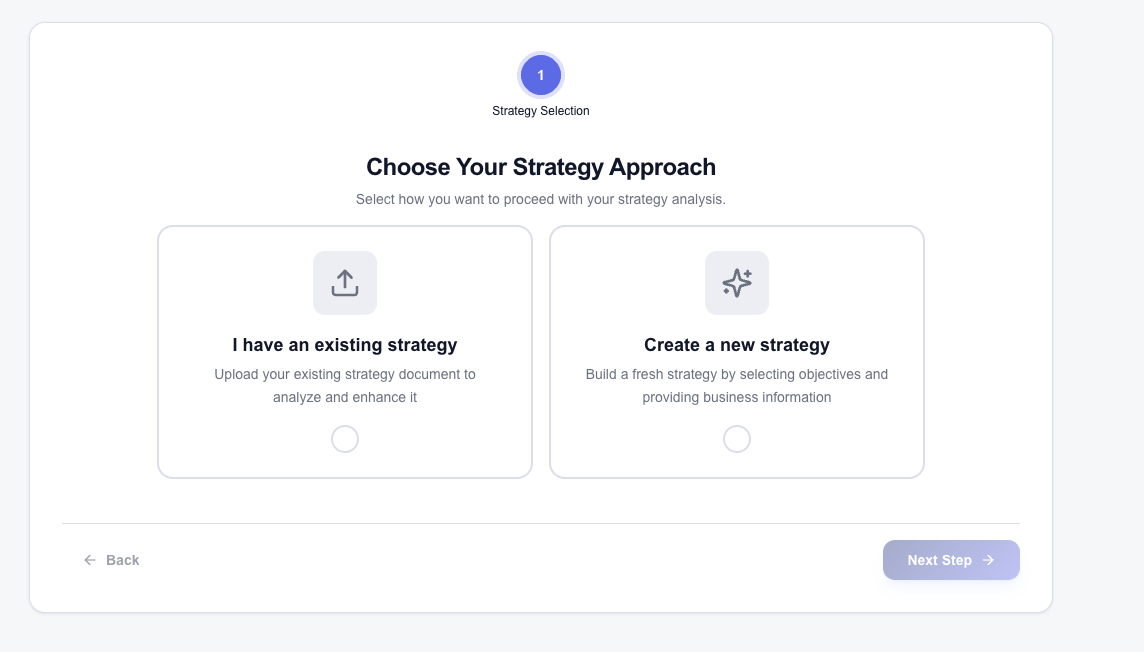
01 · Strategy
Start from the strategy you already have.
Your existing strategy comes in as the starting point, or we structure one where there is nothing usable. The AI work begins from the direction the business is actually trying to pursue.
Start from the business direction already in place.
- 02
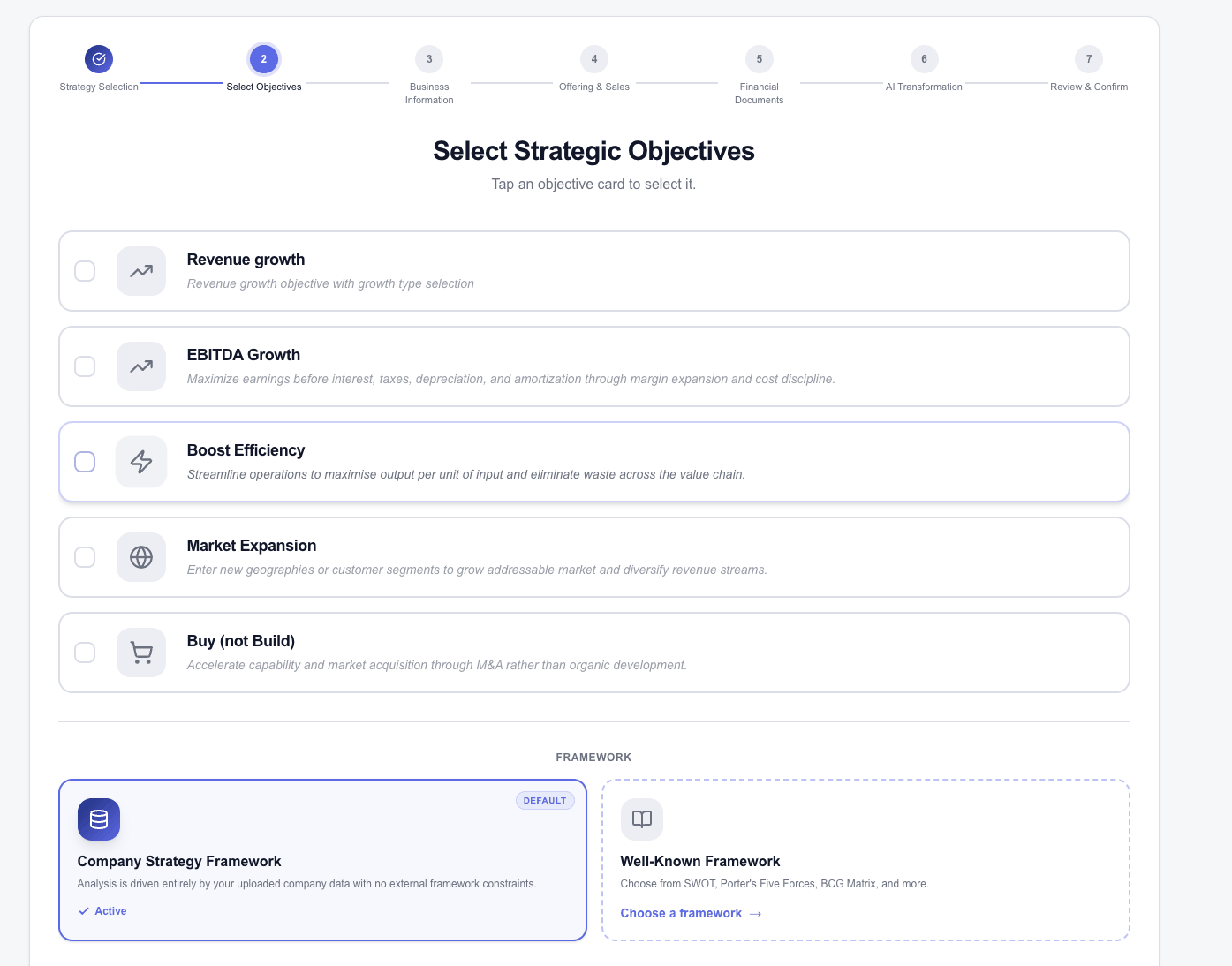
02 · Objectives
Choose the business outcome the transformation has to serve.
The objective gets made explicit before we decide on a workflow together. Growth, efficiency, expansion or something else becomes the reason for changing the work, and the thing the result is judged against.
Connect the AI work to an objective leadership already cares about.
- 03
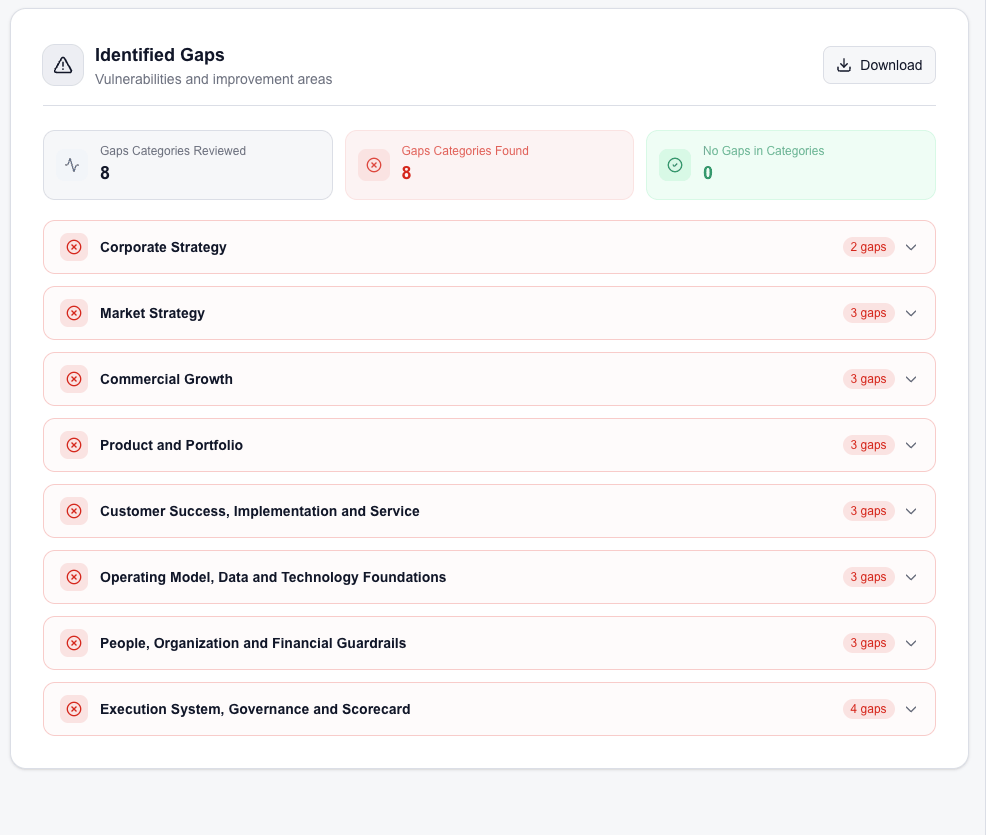
03 · Gaps
Surface what is stopping the strategy from being executed.
Gaps get identified across strategy, commercial execution, operating model, data, people and governance, before anyone assumes technology is the answer. Sometimes it is not, and that is worth knowing in week one rather than month six.
Diagnose the gaps before prescribing the solution.
- 04
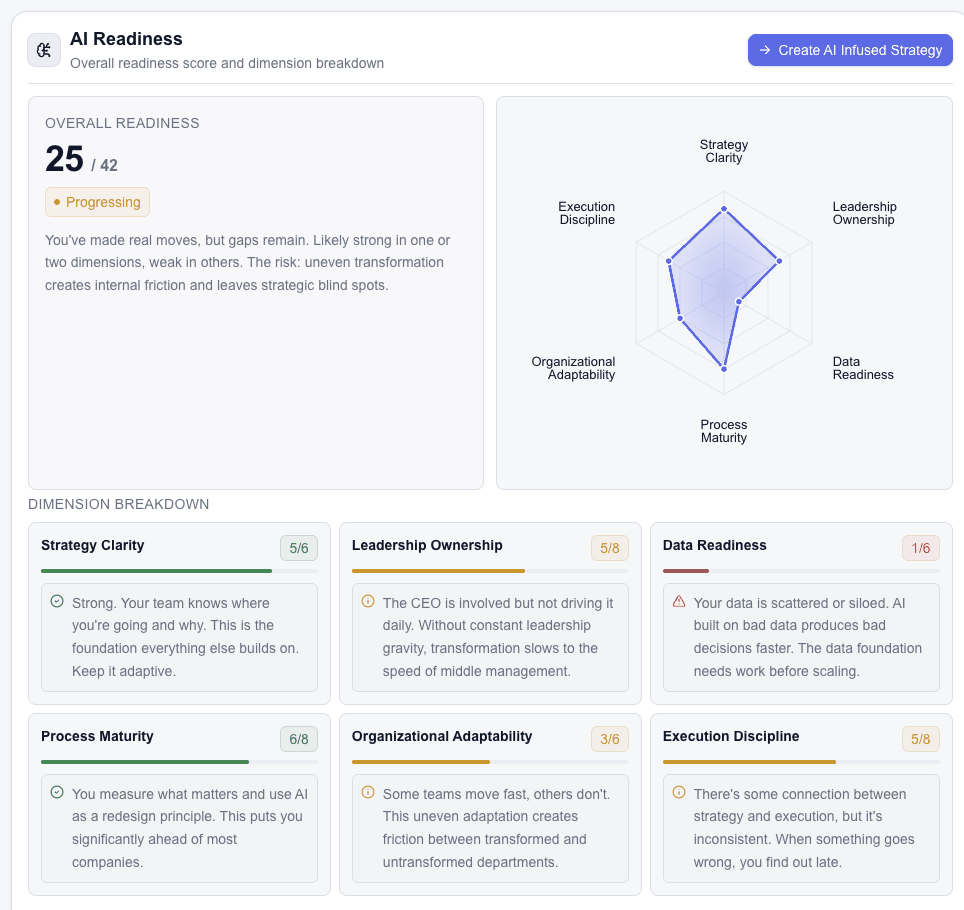
04 · AI readiness
Test whether the organisation can actually operate differently.
An assessment across strategy clarity, leadership ownership, data readiness, process maturity, adaptability and execution discipline. It is the question most AI projects never ask, and the one that decides whether the result survives contact with the company.
The question is whether the business can operate differently once an agent does the work. Whether the agent can do it is the smaller half.
- 05
05 · The decision
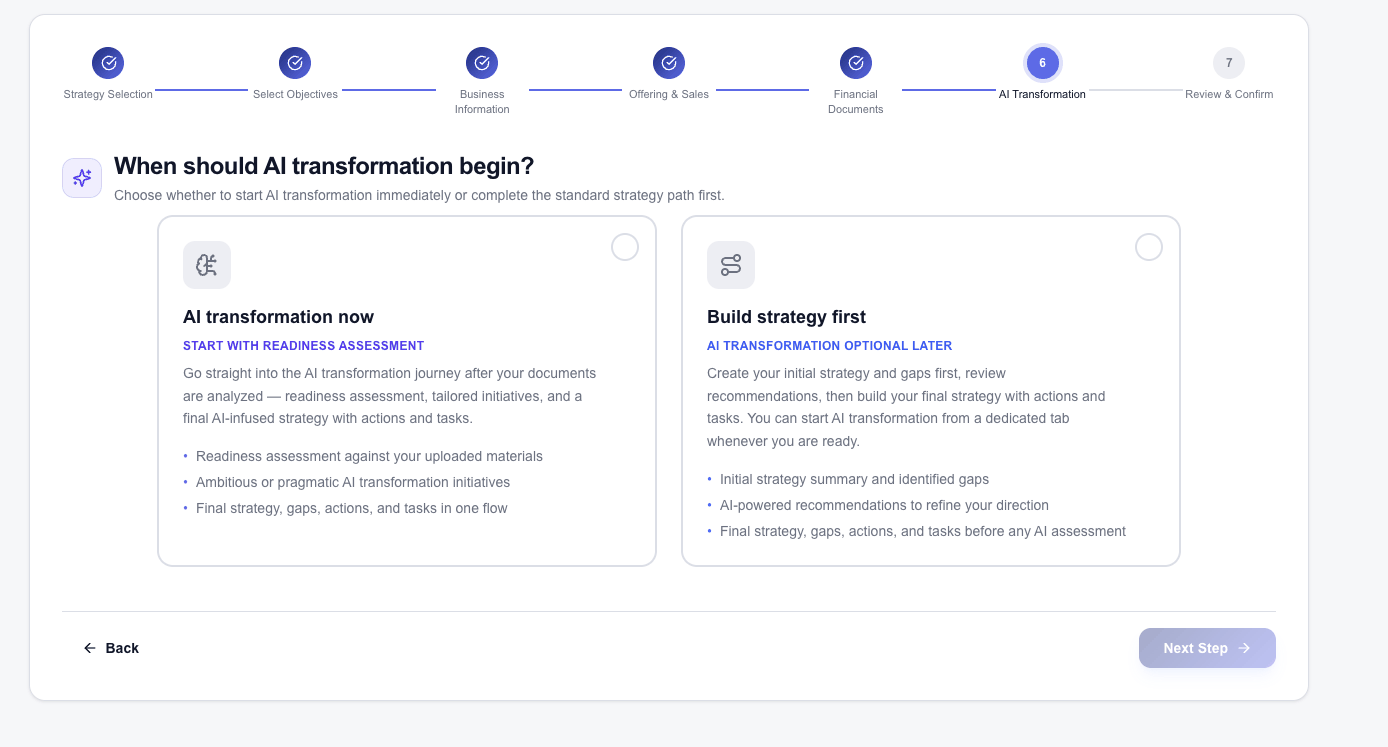
Decide where AI belongs in the path, and when.
If the conditions support it, the transformation moves into AI. If they do not, the honest move is to strengthen the strategy underneath first, rather than force an AI initiative into an operating context that cannot hold it.
AI should enter the transformation at the right point, not the earliest point.
- 06
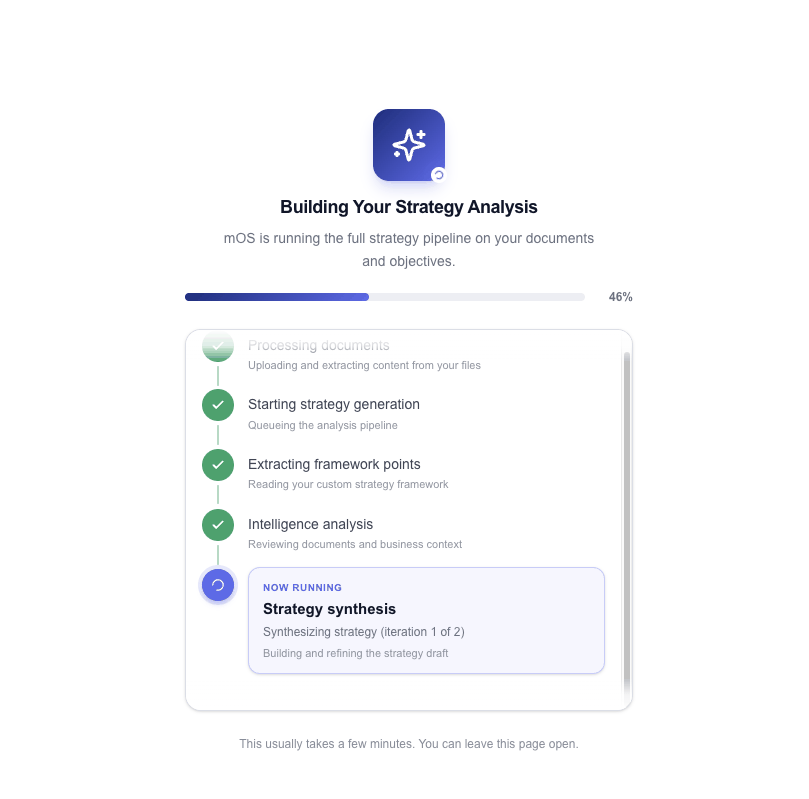
06 · Synthesis
Carry the analysis forward instead of losing it.
Strategy, objectives, gaps and readiness become the inputs to the next decision. They do not disappear into separate workshops, documents and presentations that nobody opens again.
Keep the context connected as analysis becomes direction.
- 07
07 · Actions
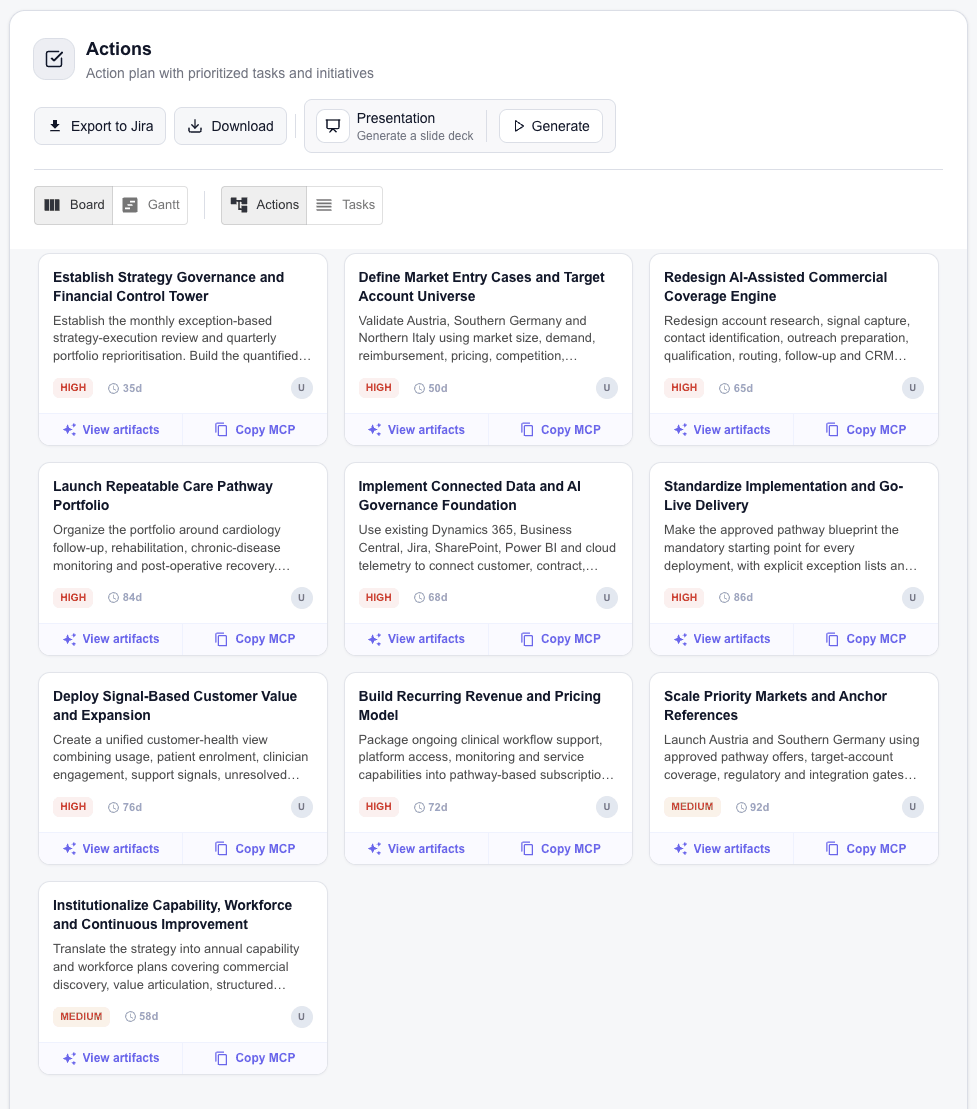
Turn direction into work somebody owns.
Recommendations become concrete actions and tasks that can be prioritised, structured and carried into execution, rather than staying a list of good ideas at the back of a deck.
Strategy becomes executable work.
- 08
08 · Timeline
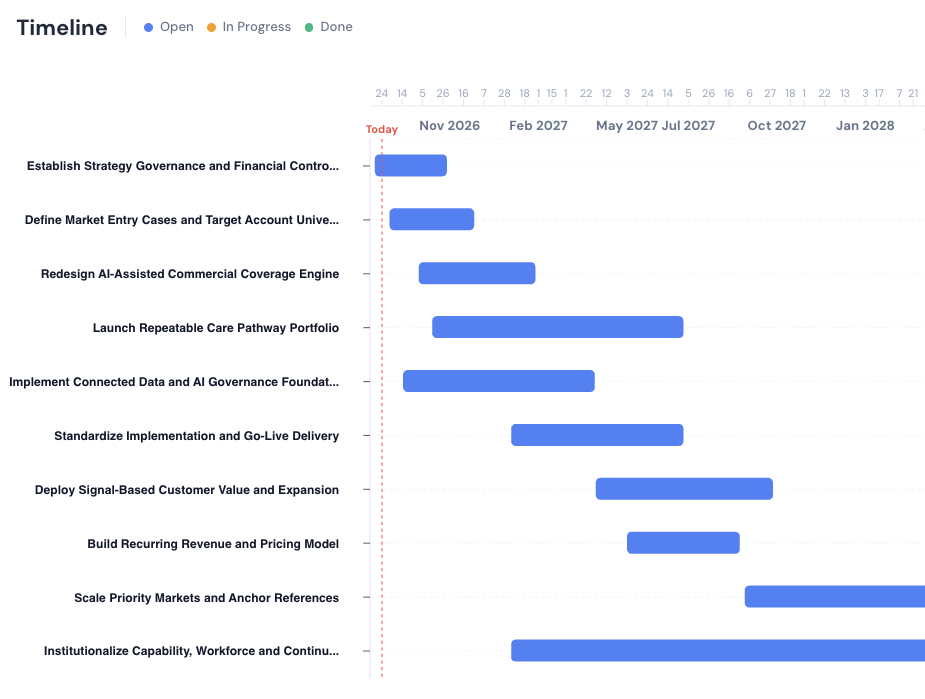
Give the transformation a sequence and a date.
The work goes onto a timeline, so leadership can see what happens when, where things overlap, and how the transformation moves from decision to execution.
Transformation becomes a sequence, not a collection of disconnected initiatives.
- 09
09 · Execution artifacts
Move a selected action into agent execution.
The action produces the implementation artifacts an agent runs on, including its MCP configuration. This is the bridge between transformation planning and the technical work that executes it, and it is the join almost nothing else in the mid-market makes.
A strategic action becomes agent-ready execution artifacts.
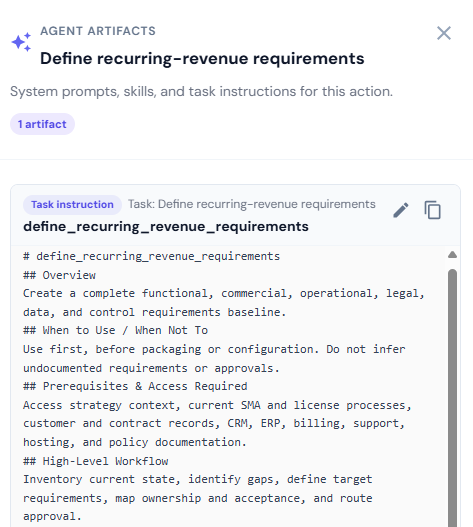
Nine decisions, one context. Each one is an input to the next, which is why the second agent is easier than the first.
Real platform screens. Expert support is there where the transformation needs human judgement, but the platform is the system that structures the work and carries it forward.
What is actually different here.
You end up with a number
The workflow gets measured before the agent touches it, by rule, and the agent does not go live until it has been. Most internal AI work has no baseline anywhere, which is why none of it can be defended, funded or repeated.
We bring the framework if you don't have one
Have it written down and we compile it into the agent harness. Don't have it and our framework supplies the best practice. An automation shop builds what you specify, and asks you to specify it.
Your agents compound instead of piling up
Each one is tied to a business priority and compiled from your workflow, so the tenth is cheaper than the first. Disconnected automations get more expensive as they multiply, not less.
It runs on your side of the fence
Your environment, your credentials, least privilege, and we hold none of your operational data. No rip-and-replace and no security review that outlasts the sprint.
A named human owner approves every real action
Until you say otherwise. Escalation thresholds are set before go-live, not bolted on after something goes wrong.
Built by someone who ran companies
Darko sat in the chair, made the calls and wrote the books, then put the method into the system so it isn't stuck in one person's head.
See where this would start in your company.
The free 45-minute AI Value Scan looks at one priority and one workflow. Next day you get a one-page map of where an agent pays first, the metric we'd aim to move, and a fixed price and date.
45 minutes. You keep the map either way.
No preparation required. No commitment.
The questions this page usually raises.
Why not start by just building an AI agent?
Because the hard part is knowing which workflow is worth changing, what the work should look like afterwards, who is accountable, and what counts as it having worked. The agent is the easy part.
Skip those and you can build a good agent that automates a task nobody needed automated, inside a workflow that stayed broken, with no way to prove what changed. That is the most common expensive outcome in AI right now, and it is not a technology failure.
Are you a consulting company or a software company?
A software company. The platform is the product, you buy access to it, and onboarding and our support come with it under an agreed service level.
The platform compiles the agent harness from your strategy and operating model. The workflow redesign, the governance and the measurement are work our people do with you in the first engagement, and work the platform keeps structured afterwards. You are not buying advice by the day.
Do we need a new company strategy before starting?
No, and we would rather you did not write one. We start from the strategy you already have.
We work through it with you: what does AI now make possible that was not possible when the plan was written, where would it move a metric you are already measured on, and what does that change about the choices in it. You end up with one strategy that has AI in it, not two documents to reconcile.
Why not just hire an AI development agency?
If you can specify exactly what to build, do. They are good at building it.
The question is who redesigns the workflow, who defines the approvals, and who establishes the baseline. If the answer is you, then the agency is the cheap part of the project.
Why not build internally?
Your team knows the workflow better than we do, and whatever they learn stays in the company. That is a real advantage and we are not going to pretend otherwise.
What usually goes missing is the baseline and the measurement gate, which is why internal experiments are hard to fund a second time. MIT found strategic partnerships twice as likely to succeed as internal builds.
We already use an OKR or strategy-execution platform. How does this relate?
Those are good at cascading goals and showing progress against them. What they leave you with is the work itself: their agents report on it, people still do it.
We start further down. One priority becomes a redesigned workflow and an agent that does part of the work, measured against a baseline. The two are complementary more often than they compete.
What if the readiness check says we are not ready?
Then we say so, and we say what would have to change first. Step five exists precisely so that answer is available.
Selling an AI transformation into a company that cannot operate differently produces an expensive failure with our name on it. We would rather do the strategy work first, or tell you to come back.
Does this mean the whole company is transformed in 30 days?
No, and anyone who says otherwise is selling something. Thirty days is one workflow, one agent and one metric.
It is the beginning of a transformation, not a claim that the company changes in a month. What thirty days buys you is evidence, cheaply, before you commit to anything larger.
Find where AI can create measurable value first.
Next day you get a one-page map of where an agent pays first, the metric we'd aim to move, and a fixed price and date.
45 minutes. You keep the map either way.
No preparation required. No commitment.
It's the first step into the 5% that really transform. The gap between the 5% and everyone else widens every month.